Showing posts with label Rahan. Show all posts

2025/03/11

Moins de sagesse que les "quatre-mains"

"We're on the mend
Where to begin?
We've got your soul in vises
The brave the bold the righteous"
 
Kidneythieves - Fist Up
 
 
For quick, concise proof that the entirety of the human species deserves to be tortured to death, play League of Legends. There is a role officially labelled support. I'm pretty much the only one actually supporting others. To the rest, it's just another opportunity to hide behind your teammates waiting for them to die so you can pick off an occasional weakened enemy. But more than that, watch the dickless little bitches constantly panic and run from teamfights for fear of being the one sacrifice that wins the fight for the rest of their team, hell, go into any team game and watch every single other player try to game the system to pad his personal score... and watch companies gleefully encourage this griefing at every step. LoL changed its rules a while back to only let you advance your characters by getting high grades during matches. Great. Except it's blatantly obvious that the two biggest criteria for this are death count and outscoring your own teammates (to prove who "carried" the team). The more your allies die, the more you profit. The less you help, the more you sabotage, the more the authorities reward you. If that's not apropos of current politics, I don't know what is.
 
The first grade under a B I ever got in school was back in 8th grade writing&composition and it wasn't a C, it was a D. If you think it's because I was an immigrant still learning English, think again. I was already sitting pretty in the 99th testing percentile and convinced I still wasn't good enough.* No, it was a group project. Four of us. Me plus a wise-cracking little girl from Indochina. Plus I forget the third. Plus one piece of degenerate all-American slum trash that could barely sound out words at a second-grade reading level. Guess which one turned up having done zero work on the last day. It could've turned out alright still, since work had been assigned officially and the teacher knew who did what, and most of our grade depended on our individual contributions... until she took us aside and started telling us how much fairer it would be to split all the points for the project four ways evenly, worked us over until we nodded along and accepted sacrificing ourselves for the undeserving troglodytic waste of oxygen that had already harmed us. That was in about '95. Compound it with thirty years' worth of both religious revival and social "justice" insanity and I honestly cannot imagine what kind of education any child's getting. All of modern society has degraded into nothing but an incubator for subhuman cretins.
 
Idaknow, maybe it was better in the caveman days. Maybe Grog 'n Grug could discern superior minds better than my retarded cunt of an 8th-grade teacher.
 
"Le baton du chef" definitely ranks one of Rahan's weaker adventures, blatantly written to order to justify that month's feelie shipped with the magazine, a replica of the titular baton. Yet another volcano's erupting (seriously, this comic had a massive hard-on for lava) and our hero must convince a local clan to evacuate. Problem: their chief enforces his hereditary authority telling them to stay because the spirits will protect them. When they finally cross the gorge to safety he's too weak to go on, and with his last breath passes the symbol of leadership to the worthiest of his clan, the one sane man who had immediately agreed with Rahan on seeking a practical solution instead of a religious one. Classic enough plot, but heartwarming as the shift from hereditary nobility to meritocracy may be, it reminds me of Galileo's exhausted reply from Brecht's play, when told "unhappy is the land that has no heroes":
"Unhappy is the land that needs a hero."**
Yes, it's nice you decided to recognize decision-making as more valuable to leadership than a rich daddy or the biggest thug around... but how much damn leadership should you need in the first place to figure exploding mountain = GTFO? Come on, Grog, you're embarrassing yourself.
 
Whom doth noblesse oblige in a democracy?
As a sequel hook, Kingdom Come: Deliverance let one of its villains escape at the end, bargaining his freedom as part of a truce. While rolling my eyes at the plot gimmick, I was better impressed by Warhorse doubling down on it when the brash young hero wants to break said agreement and hunt down their target anyway: don't! because that societal norm's reliability is all that made a deal possible in the first place. It's bigger than your personal grievance.
Do you remember, growing up, how your parents would ease off doing things for you? First you get to hold your own spoon while eating, then you're allowed to cross the street, walk home from school by yourself, get some pocket change, a cellphone, stay out after dark, have a boy/girl in your room without chaperone, start driving, etc.? Every such step is predicated on the assumption that you're growing-the-fuck-up and can be trusted to make weightier decisions responsibly. The same principle can stretch to societies.
 
"This collection of papers was not a story, not an essay, not a confession, not a diary. It was--nothing definable. It went into no conceivable covers. It was just, White decided, a proliferation. A vast proliferation. It wanted even a title. There were signs that Benham had intended to call it THE ARISTOCRATIC LIFE, and that he had tried at some other time the title of AN ESSAY ON ARISTOCRACY. Moreover, it would seem that towards the end he had been disposed to drop the word "aristocratic" altogether, and adopt some such phrase as THE LARGER LIFE. Once it was LIFE SET FREE. He had fallen away more and more from nearly everything that one associates with aristocracy--at the end only its ideals of fearlessnes and generosity remained."
H.G. Wells - The Research Magnificent
 
In ye olden days the only ones considered responsible (albeit unreliably) were the scant few princes, dukes and barons owning everything and keeping it running in their own interest. Nobody expected anything good of a common "villein" and it took millennia for control of society to gradually expand toward lesser nobles, landed gentry, the bourgeoisie and finally common men in the 19th century. (At which point women demanded overt political power too and got it in just two generations, but let's not dig into that disparity for the moment.) By his time Wells' magnificent researcher was weighing the death of aristocracy*** against the death of aristocratic quality.
 
Back around 2010, Bill Maher joked about the need for an extremist left-wing movement to match the MAGA crowd's precursors, the Tea Party, to be used as leverage making more moderate leftists look like a safer alternative. And we got it. Holy hell did we ever get overdosed on politically correct insanity in the 2010s! And he was wrong. It did not act as an umbrella for saner choices. All it did was feed the reactionary, theocratic, authoritarian backlash. Now he's half-joking for the Democratic party to prop up some everyday schlub who can relate to the idiot masses as an alternative to Trump's populism. And he's wrong. Forty years of imbecile populism is what already sat our asses onto this greased slide into societal collapse. Wokeism has championed nothing but the shallowest crass populist rhetoric, powermongering on the pretext of powerlessness, and its abject failure proves the other side will always do it better. The lowest common denominator embodiment of the people will always be the most ignorant possible superstitious backbirth hicks.
 
Stop whining about bad presidents. The elected is a product of the electorate. You're asking for a finer-crafted puppet, a glossier figurehead, presupposing some appreciable proportion of legitimate, intelligent communal will backing it, a public hand to work the puppet. Y'ain't got that! You've got a bunch of cavemen waiting in confusion for a hero to tell them to run away from an erupting volcano.
 
Trump is not an aberration. His dishonesty, greed, ignorance, narcissism, vandalism all reflect the audience which made him a game show superstar when he was just as crass, abusive, egotistical and infantile as he is now, and all your latte-sippin' urbanites cheered on a champion of anti-intellectualism for a decade alongside the hillbillies, all the suburban middle-class housewives creamed their panties at his he-man act firing others because he's rich. The current state of affairs is a cumulation of every scam and lie and petty power-grab that hundreds of millions of voters perpetrate on each other every day.
 
He's you. All of you. Every time you cheated on an exam, ducked out of work early letting your coworkers finish your share, brown-nosed for a promotion, shouted down someone making a more reasoned argument than you, every time you cut in line or drove on the shoulder, dumbed down the curriculum or defended your friend when in the wrong, took a bribe, gave a bribe, cheered your favorite sports team even though you know they're all on steroids, spouted lines like "all's fair in love and war" or "second place is another word for loser" or claimed the right to lie, cheat and steal 'cuz your lot's harder than everyone else's, you created a robber baron government, and any populist figure will be produced by the same alchemy.
"for one person to put on a cap and bells, or to go about dishonest or paltry ways of getting rich that he may spend a vast sum of money in having more finery than his neighbors, he must be pretty sure of a crowd who will applaud him." - George Eliot, 1868
Let's not pretend you're constrained to such vice, either. You're not stealing a loaf of bread to feed your starving family. The simple fact that it is impossible to play any game, from cards and dice to online twitchfests to FIFA and the Olympics, without constant and tacitly accepted cheating and sabotage, demonstrates you're not brave, bold and righteous. You're living the world you've made, apes playing with your own shit. So don't act surprised when it's thrown in your face.
 
You didn't need populist leadership but an elite electorate. Democracy could only ever have worked if the public had raised itself to expectations of nobility which the old nobility itself failed to uphold, not dragged high-mindedness down to the gutter. It has now failed. Not because you're being held down but because you drag your betters down for sheer unthinking animal competitive instinct, and have been doing so for generations.
 
What in this undifferentiated simian cesspit should inspire any better mind to action? Stop imagining you'll somehow rally and save the world from itself. There remains no-one worth working with. No plucky rebel alliance. No Terminus on the fringes of the empire. There is nothing to strive for and nothing to live for. Nothing remains worth preserving. Only dissolution. The subhuman vermin have won. Hell, I'm doing more than I should bother: a vast proliferation.
 
 
___________________________________________


* Yes, yes, I'm well aware that I really am not good enough, that I'm a worthless waste of oxygen, thanks for pointing that out, screw you too, internet.
** Technically the original line uses "unglucklich" unlucky or unfortunate - call it a sadsack land, whatever, it works idiomatically.
*** Wells followed a similar theme in The World Set Free, gently blurbed in that later paragraph from above.

2023/01/31

A House for Sorcerers

"There's no way we could have a child now. Not with the market the way it is, no."
Idiocracy's case study on smart decision making
__________________________________________________
 
"Say you wanna get in
Then you wanna get out
When you get the money
To buy yourself a castle
[...]
But you won't
'Cause it's a traaaaaap..."
 
Metric - Handshakes
__________________________________________________
 
A couple of months ago, most of my evenings were spent combing Netflix' infuriating selection of zombies, superheroes, teen comedies and politically correct sitcoms for something watchable. We were pleasantly surprised by The House, three stop-motion-animated vignettes about personal investment in the place called home. I say "we" not because I've become some snowflake plurality but because I was visited at the time by the family's token cinephile, who having suffered through some of my short story attempts suddenly muttered during the second segment: "this feels like something you'd write!" Sure enough, that one was my favorite. So, OK, my enjoyment may have been a tad biased, but still...
 
If the movie has one consistent weakness, it's the forced full length anthology format. Each segment leans a bit hard on dramatic pauses and extended takes. Given this was filmed by Netflix for Netflix, I have to wonder why they didn't opt for a half-season miniseries format, given both The House's own episodic nature and the fact Netflix' more respectable offerings have tended toward low or mid-budget European miniseries or short runners. (Even the celebrated Dark was visibly padded out to three seasons. (the sex scenes alone...)) Miniseries are the one thing you're actually good at. Run with it.
 
But I do also want to address The House's thematic focus on the all-consuming cares and worries of caring for the titular house, and for that we must revert to ages before houses. Savage ages that is, or more literally ferocious ages.
 

Rahan didn't deal much with home ownership, being a caveman comic. Caves and huts and the odd lake-house or tree-house existed, were inhabited, and occasionally made plot points, but more often than not our fire-haired hero spent his nights on a tree branch, because nothing says superior intellect like sleeping outdoors with only a leather diaper for warmth in the younger dryas. Anyway, while doing his itinerant troglodyte lecturer routine, he runs afoul of a tribe that's come up with a quitessentially paleolithic solution to the problem of nerds. If you hear anyone voicing new ideas, toss 'im down a big hole! Naturally, our undeterred protagonist leads the nerds who welcome him at the bottom of Le Piège à Sorciers in a daring escape via cutting-edge seesaw technology (yes) and finally, in the comic's general spirit, they scatter their think tank to the winds, each knowing, whatever comes, that the others, somewhere, are combatting savagery and ignorance.

Except savagery and ignorance are monetizable. We don't want that shit combatted. For all that home ownership is presented as a logical, sensible and wise investment for the upwardly mobile, for the sorcerous (or rather, wizardous *sniffs contemptuously) among us it manifests more as a trap, a hole in the ground where intellect can be buried and busied scaling unscalable walls. I found The House's first segment rather dull with its dull, salt of the earth yokel protagonists, but the second and third segments center on practical, vivacious, urbane entrepreneurs (grating as their quirks may be) whose existence is obscenely degraded by their self-adjudged gaoling.

Granted, buying a house, buying a bigger house, buying the biggest house suits our species' most pervasive need for intra-tribal competition, for conspicuous consumption manifested in the most conspicuous form of property, but beyond that any natural justification dives into fallacy. There's no instinct for granite countertops, or yoking yourself to a mortgage, or two-story foyers or the other nonsense tacked onto our desperate thirst for ever more status by profiteers fleecing us so they themselves can buy the even biggest house, and so on.
 
I do not know how true it may be that a house is a good investment. Logically, resalable property is more reliable than volatile currency, especially if it's a necessity like shelter with a high unit cost. However, this implies a certain stability, as all through history people(s) who expected to be run off the land any given month found it more worthwhile to invest in portable wealth like jewelry or the family silver. At the other end of the spectrum, centuries of land-rich, bankrupt aristocracy demonstrate the need for property's utility, and for a residence that means... residence. The notion of a house being a good investment depends on finding someone willing to pay you a surcharge for your second-hand cave, man, which in turn is a figment of the 20th century's criminal upsurge in human population. Housing bubbles depend on population bubbles. This will not last. Either civilization must collapse by an order of magnitude to survive, or, far more likely, it will collapse entirely, but either way future generations won't be lining up to buy your two-story plywood-and-spray-foam cookie-cutter monstrosity in the dead middle of buttfuck nowhere.
 
Forgive the previous paragraphs' digression, but it's become entirely too fashionable to bemoan younger generations no longer buying houses. That's probably the best thing they're doing. A realtor with a hundred houses can be said to own them, but if you can only afford the one you live in, it owns you. Just ask the millions of families who lost everything back in 2009, and the investors who bought private islands in the aftermath. We need to stop imagining that grudgingly permitting the little folk to "own" some property will allow them to stand up to our moneyed aristocracy, give them security. Ownership is relative. Unless private accumulation of wealth is capped, the top of a skyscraper will always find some way to leverage that wealth toward dispossessing you of your precious little cottage or devaluing it to starve you into slavishness.

You are not a homeowner. You are a self-deluded drudge maintaining a property to enrich the rich, who love taking a cut not only of each resale but of the myriad parasitic transactions associated with a property, all the repairs and replacements, all the permits and salaries for all the go-betweens, gatekeepers, lawyers, third assistant sub-comptrollers and hardworking lawn flamingos. You say you saved money in the long run instead of renting? How much of your fucking life went into that glorified shack? As I was watching The House I couldn't help recalling my parents and I re-flooring our old place, three of us on our knees day after day, measuring, cutting, cleaning, fitting, hammering planks like out-of-work pirates. That and the gutters, and the yard, and the back yard, and the basement and the tree branches out front, and the pipes, and the outlets, and the chipping paint, and the stuck screen door, and the slanted mailbox and the shorted-out garage door, and the... everything!

That is not a life of the mind. It's drudgery, and that's not a bug, it's a feature. Though less direct, the final benefit the aristocracy draw from suburban sprawl is the inefficient effort itself put by individuals into individually maintaining those uselessly oversized living spaces, taking up their free time, piling on anxiety after anxiety, anchoring your entire existence more solidly than even the job you can't afford to quit. Keeps you too busy to think. It's just one more modern means of extending feudalism, continuing to tie serfs to the land, treating you as an extension of the property, just another lawn flamingo. Your house is an oubliette, quicksand for free thought, a particularly apt trap for high-INT sorcerers because it really does appear, on the surface, to be the smart, sensible, logical investment. (Caveat in the fine print: what you invest is not just money, but your life, to be reaped by the wealthy at their leisure.)

You don't need a house. You need a cheap, clean, safe, quiet, no-frills, greenery-adjacent, private living space maintained by efficient professionals, because even misspelling angry YouTube comments is a better use of your time than cleaning gutters. We don't need suburban sprawl with monoculture lawns. We need better-regulated cities with livable apartments.

2018/09/29

Holocene Detective Fiction

Spoiler alert: Rahan knows that one can shoot things with a reed!


Rahan does indeed also know that one can make music using a reed. (In fact, he invented the flute.) Rahan knows many, many things. Rahan always wants to know more things. Thus when Rahan encounters a suspiciously large tribe ruled by an omnipotent supreme leader, Rahan investigates said lethally godlike powers.
Come, ivory knife, the prehistoric game is afoot!

Now, you know Le Chef Des Chefs is a totes awesomesauce story because it's got an arena fight against three different kinds of panthers... and that's not even the climax! The A-plot revolves around Big Chief Cue-Ball's supernatural ability to call death on his victims from afar through no visible means (spears, arrows, rocks-fall-everybody-dies, etc.) from the safety of his shadowed hut. Rahan, upon performing a quick post-mortem of one of the victims, discovers a tiny plant spine embedded in his skin. When he finally works his way up to the boss battle above, he puts two and *this-many-fingers* together at the sight of the chief's blowgun, a very surreptitious means of killing unfamiliar to his tribe. That thar be sum fine dee-ducin' yo.

Every time I go back to re-read some issue of Rahan, I rediscover amusing details. Lecureux Sr.'s imagination in creating tension and mystery for stone-age plots is admirable, but as I've grown older I've especially gained an appreciation for Andre Cheret's artistic skill. Tiny details like the chief's eeee-veel pointed fingernails and wriggly quavering untrustworthy speech bubbles didn't register consciously to me at eight years old. Neither did the fact that they totally cheaped out on coloring Rahan's skin in that first panel (check it against the background sky gradient) and yet it still works in as far as he's supposed to be back-lit and shadowed. Then there's the red-shifted third panel, the moment of revelation, the split-second when the dramatic tension breaks, aided by the chief's speech bubble suddenly reverting to serious, standard form (when the villain cuts his monologue short, look out!) and by the speed lines suggesting he's lifting the reed up suspiciously quickly. Without belaboring every such detail, handing us the sensory data by which Rahan suddenly solves the case went a long way toward putting young readers in the hero's shoes.

Caveman detective fiction. Not the most predictable genre mash-up. Not very frequent in Rahan either. Most issues of the comic tended toward co-op PvE rather than PvP encounters. Yet once in a while Rahan had to unveil some evil oppressive autocrat's means of deceiving his tribe into obedience or sleuth his way through a good old-fashioned stone-age murder mystery. Mystery is itself gradually becoming a historical genre. Modern crime solving is highly technical and not very dramatic, thus audience-unfriendly on two fronts. So, many authors stick to Agatha Christie's 1950s or interwar settings, before the panopticon had turned all of London into a voyeur's paradise. Victorian England (or the Victorian anglophone world) is of course another favorite as the setting for our prototypical fiction of sleuthery, Sherlock Holmes.

So I got to wondering how many historical detective fictions I'd personally encountered. After all, murder most foul adds spice to any setting, and even though neither murder mysteries nor period pieces are my "thing" it's amazing what you run into in the course of perusing good art.

Stone age: Rahan
Medieval: Cadfael
Renaissance: The Name of the Rose (technically set pre-Renaissance, but its tone definitely matches)
Victorian / Edwardian: more than I care to recall.

Now, it strikes me that I'm missing vast swathes of history in between there. Why have I never read/watched/comicked a modern detective story set in Ancient Rome, for instance? Wikipedia lists quite a few and I'm certainly not averse to reading about Vestals gladiusing Praetorians or what-not. Are all those books just crap, beneath notice? Same goes for Ancient Egypt. It's a theocracy in a half-desert, half-swamp environment. You'd think the intrigue and scene-setting would write themselves. Plus, everybody's got kohl-blackened villainous eyes! Or what about the Enlightenment Age? Leyden jars, astronomical ellipses, private collections of exotic fauna, all that pre-steam steampunk has got to make for a captivating backdrop. Where's all my musket-murder mysteries at?

Being mainly a science fiction fan, I have to note the relative scarcity of futuristic mysteries as well. Isaac Asimov took a stab at it with some of his Robot stories. Aside from that, the mystery of future technology and the mystery of Mystery might seem redundant. Unveiling two things at once is overkill and overwork. Why blow two wads on one manuscript when you can split the concept up and sell two books? Amirite, writers? Plus, it's hard enough getting the technical know-how to dream up hard science gimmicks without also failing to imagine realistic uses for them. The mystery genre can't even keep up with the possibilities of cellphones, much less Johnny Mnemonic implants and hyperspace quantanets.

Paradoxically, setting anything during the better studied historical periods runs into the same caveat. Three pages into your civis romanus murder mystery you'll have three dozen geeks writing you angry e-mails for having totally mis-represented the piss-boiling process for wool-padded Legionnaire leather armor. Write Carolus Linnaeus into your story and you'll get half the botanists in the world sending you angry lilies. Don't even dare touch Babylonian prostitutes. (No, really. You don't know where they've been. (Babylon, maybe?))

It does seem like pre-historic whodunits hit upon a winning formula: each can hinge on simple social systems and some modus operandi utterly mundane by today's standards (like blowguns) but unknown to Caveman Grog. Other than that, maybe one can take refuge in obscurity. Given that murder most foul can freshen anything, make your setting anything. Set it in 1200s Teutonic Estonia or Post-Roman Moravia or some lowland backwater of the Incan Empire in the 1400s. You'll have much fewer expert sources to read. All five people who give a shit about the topic will probably just be too glad to see it get some attention to really quibble over details. As for everyone else, let them come for the poisoned darts and stay for the quaint trivia.

Just provide us with some speed lines and speech bubble shifts to help us keep up in unfamiliar terrain.

2018/01/23

Citizen of the (Prehistoric) World

"And the road becomes my bride
I have stripped of all but pride

Only knowledge will I save

And my ties are severed clean
Less I have the more I gain
Off the beaten path I reign
Rover, wanderer, nomad, vagabond
Call me what you will"

Metallica - Wherever I May Roam

_____________________________________________
Spoiler alert:
The Earth is round like a fruit.
(You think I'm kidding? It's still news to some idiots.)

_____________________________________________

I leafed through my share of comedic comics and superhero comics growing up, but my indisputable favorite was a 1970s* French throwback to late 19th or early 20th century adventure stories - set in the stone age. Rahan distinguished itself by (aside from its high loincloth quotient) its firm reliance on and promotion of rational inquiry. The villain of the week would more likely than not come in the form of a tyrannical mystic to be debunked by the hard light of reason. The monster of the week was often supplanted by the applied science/engineering problem of the week.

How the hell do you introduce a stone-age egalitarian scientist to your presumably tween audience? I mean, some origin stories make excellent comic book first issues. Superman? Exploding planet? Total boy scout bait. However, in cases where the origin story is either too complicated/multiplicative (X-Men) or ever so slightly esoteric (Sandman) you tend to encounter mysterious heroes already engaged in medias res, kicking names and taking ass and expositing as they go. Early Rahan comics don't bother much with backstory and just try to establish the essence of Rahan-ness. So, his first adventure The Secret of the Sun has Rahan chasing down a kangaroo and getting whanged over the noggin with a boomerang in the shade of a perpetually erupting range of volcanoes.


Time out.
First off, red kangaroos hit a top speed of 70 km/h; Usain Bolt set the latest human record at just under 45. Also, trying to sit on a kangaroo's hindquarters like he is in that last panel would likely just get you sprung into orbit, unless you're a comic book hero. Thus we've already established Rahan's superhuman (albeit entirely natural) abilities.
Batman in a leather diaper? Check.
Second, seems patently ludicrous to insert both a kangaroo and boomerangs within the first two pages of the first issue of the comic, seeing as it generally had little or nothing to do with Australia. Upon consideration, however, it made for a clever compromise between situating the comic's primitive setting and not blowing their entire wad by immediately overusing Mastodons and Smilodons. 1960s-'70s European pop culture was already saturated with adventure novels and movies set in such exotic, thrilling, primeval locales as the South Seas or the Hollow Earth or Darkest Africa or... ummm, Kansas. Well, they can't all be winners. Australia instantly established the comic's genre to its target audience without being too on the nose.
Third, yes, he is indeed interrogating the kangaroo... as to where the sun sleeps at night. Moving along.

That odd little segue leads into the main plot: the adolescent Rahan has set himself on a quest to find the lair of the sun god so as to persuade it to shine constantly because he's afraid of the dark.
That panel's either copycatting a very famous painting or Captain Morgan. Either way, good job re-iterating the romantic adventure setting.

One of the funnier facets of our pop culture expectation of prehistory holds that it was full, absolutely full of erupting volcanoes, and this comic didn't disappoint. Look at that: firestorm plus white birds. It's like a John Woo adaptation of the Paleolithic. Rahan's very origin story consists of losing his tribe to a volcanic eruption, and every few issues he'd run smack into another one just as it was a-splodin', nearly all of them inhabited by human tribes inexplicably building their homes almost atop the caldera. Big empty planet but when everyone picks a settlement spot they all want to sit their asses on the nearest fiery rockpile of doom.

Or maybe they didn't have a choice. I mean, look at that landscape, something out of the Hadean. You can't swing a dead pterodactyl without hitting a cindercone around here. Wait, weren't we in boomerang town? Y'know, the place not particularly known for volcanic activity? Tectonically, Australia's practically defined by being not_on_the_ring_of_fire, unlike its smaller northern neighbours. We know we're on the mainland because Lecureux went to some pains to establish young Rahan's unfamiliarity with large bodies of water. It's actually a point of character development that he learns to swim as a result of needing to cross large rivers in his mad crusade for the sun god's cave.

Constantly chasing the setting sun he at last dead-ends into the western shore, almost drowns trying to ride a giant tortoise across the ocean (tell me you haven't wanted to do that) and at last decides to seek out new worlds and new civilizations rather than a mirage. He mocks the sun god with impunity.


Lookie there, more eruptions.

What's that? You need a supply of fresh water for high seas adventures? Nonsense. He's Batman, remember? Surfing the (presumably Indian) ocean on his raft the size of a cafeteria tray, he lands on an inhabited island and witnesses a boat race. Seeing one boat lap the other around the island induces the epiphany of the sun circling the earth to rise at the opposite horizon every day, and the realization that the world is round. "Comme un fruit!" Suck it, Magellan!


Turns out the natives there are enlightened noble savages never fighting either amongst themselves or with other islands, venting their competitive instincts in harmless contests instead, like boat racing. Cue epiphany #2 "we don't have to kill each other" and Rahan sets off for the next exciting issue. Thenceforward his task is to explore the world, spreading wisdom as he goes.

Look, another erupting volcano! And another one! And - oh shit, you thought I was joking about the pterosaurs, didn't you? Bitchin'! Cue bare-chested hair band electric guitar solo. BbrrrraAAaaannNGG! BadabadabawannNGG! Check out the pecs, yo!
Heheh. As much as I have to laugh at seeing it now, twenty-five years worth of perspective and scientific knowledge after I first read these lovely picture-books, I still love them. The wolfy doth protest too much.

I'm not sure Cheret ever again drew Rahan quite so stubby and barrel-chested, and rarely gave him chest hair. In fact he's usually drawn and explicitly described as slim, youthful and agile compared to the musclebound, hairy, brutish tribal chiefs he opposes. Typical dashing young rebel. Here it's likely meant to show the passage of time, since the first issue of the comic covers several years' worth of prehistoric walkabout. Our hero is no longer the naive, slim youth of twenty gloriously colorized pages ago but has become A Man ready to take on the world. As with most serialized works, the earliest installments (for better or worse) read and look slightly differently from the rest.
The boomerang, though adopted in the first issue alongside his ivory knife and five-claw* necklace as though it's here to stay, is dropped with no fanfare from future installments. Just as well, as it was too culturally-specific for a globetrotter.
Graphically, Rahan himself would become more polished and consistent in his features and proportions and the backgrounds would grow more detailed than in the first few issues, etc. That badass windblown hair look gets used more sparingly later on.
The plots would become more nuanced as Lecureux settled into his groove of presenting Rahan with natural phenomena/mysteries from which he deduces a solution to the tribe of the week's current dilemma.

That the comic plays fast and loose with its geography, paleontology and biology is to be expected given its 1969 debut fast on the heels of the wildly successful Flintstones. Geographically misplaced or kaiju-sized versions of normal wildlife and anachronistic dinosaurs crop up with some regularity, and Rahan's body possesses a small trace of the usual implicit superhero healing factor and resilience to blunt trauma. However, compared to the other, more Conan-ish sword and sorcery takes on prehistory from preceding decades, Lecureux and Cheret kept things surprisingly down to Earth*. Compared to inventing and inserting racial memories into Neanderthals, the odd T-Rex here and there seems almost natural. By and large they stuck to real-world conflicts and technologies, and much of the comic's charm lay in reinventing such mundane objects as flutes, hard-boiled eggs, fishing poles and magnifying glasses through the wonder of a primitive mind.

Centering much of the comic on reinventing the wheel (at least from the reader's perspective) served Rahan as well as it always has Robinsonesque island adventures, with the added bonus that a young fan would not only share in knowledge of such simple technologies (I've heard of aqueducts, who says I haven't) but in the caveman's exultation in divining their operating principles (oh, one end has to be lower than the other?) It tiptoed the knife edge of "edutaiment" with rare grace. More importantly, it extended that same principle of rational inquiry to Rahan's own outlook on the world, right from the first issue. He's no declared atheist, quite willing to speak in terms of gods and spirits, but also skeptical of ever encountering one and always, always willing to pull Santa's beard.

Though arguably fitting the noble savage trope, Rahan's not born englightened. In the very first issue, he has to be told that:
1) kangaroos aren't people, dumbass
2) nobody's ever found the sun's sleeping cave, dumbass
3) not everyone kills each other on sight, dumbass

The moment of iconoclasm in that third image where he basically tells the sun "screw you, man, I'm outta here" in fact recapitulates in the very next panel a process very familiar to most atheists, the lingering irrational fear of divine retribution during the period of adjustment after ceasing to believe. Unlike most speculative pulp fiction, Rahan didn't stop at presenting discoveries, but gloried in the process of discovery. Observation, hypothesis, testing, theory. If the sun does not avenge insults, maybe the dark is not to fear either? You're blowing my mind, dude.

Perhaps most importantly, Rahan's intellectual freedom extends to his interpersonal relations. He never allows himself to be trapped in a long-term sexual relationship* and never swears fealty to some arbitrary in-group* and is frequently faced with the treachery hiding behind facetious niceness. The son of all clans, of all hordes, of the grand horde of humanity, bases his do-gooding not on instinctive sympathy and other emotional manipulation but on the general principle of a higher good. His gift to those-who-walk-upright is the dissemination of knowledge.

For the sake of human interest, each issue of the comic ladled on more than its share of monsters, violence, drama and cave-girl boobies, but true to its publishers' socialist/communist roots it presented a constant message of equality, the greater good and personal freedom which is far beyond even today's pop culture. Those same socialist roots also explain why American audiences have never seen so much as a single blond hair of the son of the savage age. So if you're looking for a creative gift for a ten-year-old, give Captain Ugly American a rest and try digging up some copies of the old original run of Rahan*. Bonus points if you get them in French and ensure the little bastard an easy A- in his foreign language courses.

("Minus" because he'll probably think all French is spoken in third person.)
(And a hard slap in the face from the first paleontologist he meets.)


______________________________________________
* We do not speak of anything labeled Rahan after 1984.

2013/07/15

Rahan: le fils des ages farouches

Formative years.
How much are our personalities shaped by our early imaginary role models? Would I be different if I had grown up reading comic books about military macho-men fighting for flag and country or would I still be my recidivist self?

Rahan. It would be unfair to begin this description by saying that the comic is set in the stone age, that Rahan is a caveman. Rahan is an idealized intellectual in the existential vein. He is a free individual, traveling the world helping his brothers and sisters, those-who-walk-upright, to survive the brutal demands of the prehistoric world. A vital, proactive exemplar of human virtue, he is part scientist, part explorer, part statesman, part rebel, part inventor. A renaissance man. A world citizen. Rahan is globe-trotting enlightenment in a loincloth.

Normally I'd link something here, either the wikipedia page, or the official website. However, no single presentation I can find online does it justice. In a nutshell, this is what I'm talking about: the original collection, written and drawn back in the 70s by Lecureux&Cheret, 27 issues of usually three stories each. The Nouvelle Collection contained good material but much of it was reprinted older episodes or if new often of lower quality, slightly more sensationalist or repetitive, showing signs that Lecureux was running out of steam. I don't particularly care what came afterwards. Apparently there's been a televised cartoon series and Lecureux Jr. took over writing the series, and sometime in there it turned into something not worth mentioning.

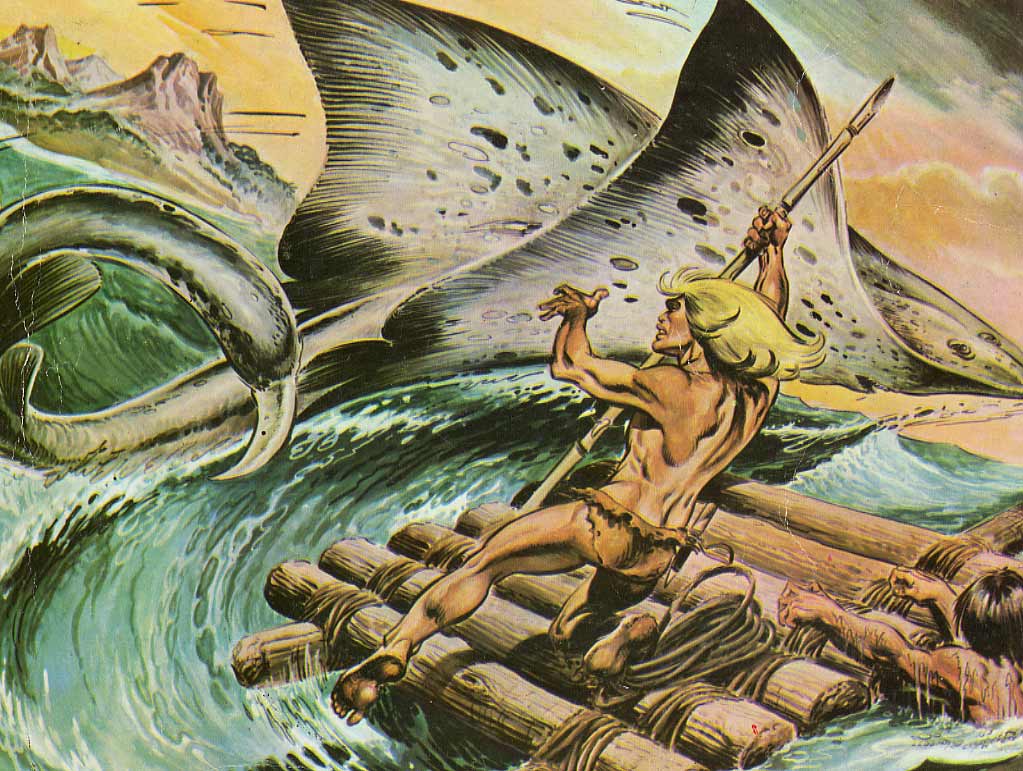
But ah, the old stories. They were carried as much on Cheret's art style as on the writer's knack for dreaming up stone-age scenarios. Maintaining a sense of wonder whenever a flightless bird or anachronistic dinosaur or giant stingray crashed into a panel hinged on maintaining an overall low-key, realistic, well-proportioned setting, and the drawings do this while also keeping the perspective pretty consistently locked close on Rahan himself, an almost first-person experience.

Loyaute.
Generosite.
Tenacite.
Courage.
Sagesse.

Rahan has two possessions (aside from his leather diaper) - one is his ivory knife, a symbol of both his freedom and wanderlust and his sheer will to live. The other is a necklace of five claws, each representing a virtue, passed among the chiefs of his doomed former clan and finally handed to him by his dying father in the midst of a volcanic eruption. Very dramatic.
Funny. They didn't feel the need to add 'and the French way' after wisdom and loyalty. He also never demands to hear the lamentations of anyone's women.
If the necklace is Rahan's conscience, his superego, then the knife is his id, his impulsiveness, his drive. Most adventures begin or end with him twirling ye olde coutelas d'ivoire on a rock, skull, upturned pot or other round surface so it can show him in which direction to travel next.

There is a good deal of variety in the adventures. There are monsters to fight in some, landscapes to traverse in others, tribal chiefs to depose elsewhere. There is never, EVER a true supernatural element involved, discounting the anachronistic dinosaurs or overgrown wildlife. Ghosts, spirits, gods and magic of any kind are always shown to be products of misinterpretation of natural phenomena or of deliberate deception.

Many stories are just adventures. Rahan has to overcome a challenge and he uses some natural principle like melting and re-freezing water or invents anything from fishing poles to aqueducts to oil lamps or the flute in order to do so. Others showcase a single interesting one-shot character (Le sacrifice de Maoni, Le rire de Tanaka.) A couple are sprawling epics (La valee de tourments.)

However, the most relevant to my developing mentality as I devoured my uncle's old collection of comic books was the fact that in every issue of Rahan, reason, intellect and fairmindedness triumph over brute strength, tyranny and ignorance. The most common recurring villain archetype was a tribe's shaman, witch doctor or other type of mystic keeping his people enthralled to superstition and miserable subservience. And Rahan trounced them. Every single con-man.

There's much of Rahan still rattling around inside my skull. Tenacite, bien sur. As much as I can. Et courage. I don't always live up to it, but I try. Loyaute ou generosite, not as such. These are social functions. Perhaps I simply have not found a deserving tribe as yet. Mais la griffe de sagesse, cela has dug a furrow to my heart...

My kingdom for an ivory knife.